If you would like to subscribe to receive an email notification when a new blog post is added to this site, please scroll down to the bottom of this page and click on the black triangle to reveal the widgets. There is a box there to enter your email address and then you have to reply to the confirmation email. Please scroll down to see the most recent posts.
Three Weeks in France on Instagram
New work, Smaller PaintingsI have recently arrived back from a delightful 3 week trip to France staying with my daughter, Sasha (@therusticretreatfrance) and her family, at their place in Sante Sabine in the hills above Sant Antonine. As a result of some tuition from Sasha, I have been posting more frequently to Instagram – my work in progress, past work and some video reels. If you are on Instagram, you can follow me at @synapticconnections. If not, the posts go up on facebook at the same time.
View this post on Instagram
I am just experimenting here with embedding a few of the Instagram posts. And a couple of diary entries follow.
View this post on Instagram
13 September 2023
Shortly after I arrived I found it impossible to do anything creative or write anything coherent. The weather has been so hot here that activity of any sort was only possible in short bursts between siestas. Soon after I arrived the family began to follow. First Beatrice coming from Lourdes, where she had been staying for a few days, then Becky with Garry and the two boys.
For the weekend just gone we had a welter of meetings, meals, supermarket visits, river trips, pizzas on the square at Sant Antonine watching rugby (Becky’s family are very sporty) endless talk and laughter. It was a great time of bonding between families that have hardly been aware of each other until now. My sister and I took a pleasant backseat watching it all happen. Everyone dispersed on Monday morning.
But yesterday the weather cooled and I was able to turn my mind to painterly things. I was glad of the chance to mull over what direction I wanted to explore while I’m here. The light here is stupendous, although a summer of blazing sun has parched the fields, and reddened the tips of the trees. I decided to try a completely different approach than using black and white, and find some way of responding to a world of colour, intensity and deep shadow. Sasha showed me a catalogue they had bought on a recent trip to Collioure on the Med where Matisse and Derain had lived for a while. It was the birthplace of the Fauvist movement. It reminded me of a short obsession with that movement when I was little more than a boy, when I produced a series of paintings (all of which have disappeared without trace) that maximized the brilliance of colour. I’ve decided to pick up where I left off using a small pile of square boards that I found in Sasha’s large barn.
I hope the heat here has now abated. It’s impossible to work in temperatures over 30, I find. But during the last couple of nights there has been a welcome fall of rain, bringing with it a fresher feel.
View this post on Instagram
26 September 2023
It’s been a lovely day today, warm and sunny from morning to night. Everything glows with light here, the sky seems to be full of prisms. I am struggling to finish my last painting before leaving on Saturday, but I’ve promised to do some sign writing before I leave. Today we went to look around a gallery in the old Cistercian Abbey Bilieu.
View this post on Instagram
View this post on Instagram
Quest for Erotokritos Exhibition open until the end of October
New workIntroduction

One of the spaces in the exhibition
There’s still time to see the exhibition of my work that was inspired by my trip to Athens and Crete early this year. The large canvases in charcoal and pastels remain on display at St John’s Hall Gallery in Barmouth (Wed-Sun 12-4) until the end of October. The images can be previewed on this website here. So far I have written two blog posts about my trip here and here with more to come.
This post has more information about Erotokritos the man, poetry and song.

Another view of the hung exhibition
Erotokritos the Poem
Erotokritos is a poetic romance considered to be the masterpiece of Greek literature. It was written by the Cretan poet Vitsentzos Kornaros in the late 16th century, during the period of Venetian rule over Crete. The poem is written in the Cretan dialect and consists of 10,012 fifteen-syllable verses, making it one of the longest works in the Greek language.
Erotokritos tells the story of two young lovers, Erotokritos and Aretousa, and their trials and tribulations in their quest for love and happiness. The narrative is set in the mythical kingdom of Athens and focuses on the theme of true love, honour, and loyalty.
The protagonist, Erotokritos, is a noble youth and a brave warrior who falls deeply in love with Aretousa, the daughter of the King of Athens. However, their love faces numerous obstacles, including social class differences, political intrigues, and the interference of other characters.
The poem weaves together elements of folklore, mythology, and history, creating a rich tapestry of the Cretan culture and its values. It explores themes such as chivalry, courtly love, and the importance of personal integrity. Erotokritos is portrayed as a paragon of virtue, demonstrating courage, loyalty, and unwavering devotion to his beloved Aretousa.
The language of Erotokritos is highly poetic and lyrical, characterised by its rich imagery, metaphors, and elaborate descriptions. The poem incorporates elements of traditional Cretan folk songs and dances, adding to its cultural significance.
Erotokritos has had a profound influence on Greek literature and is regarded as a national treasure in Greece. It has inspired numerous adaptations, theatrical productions, and artistic works throughout the centuries. The poem’s enduring popularity is a testament to its timeless themes and the skillful craftsmanship of Vitsentzos Kornaros.
Erotokritos as a popular song

Aretousa – Charcoal on Canvas,1m x 1m
“Erotokritos” is indeed a popular song in Greek music, and it was performed by a number of artists including the renowned Greek singer Nikos Xilouris. Here is a description of the song:
“Erotokritos” is a ballad that takes its name from the famous poetic romance by Vitsentzos Kornaros. Nikos Xilouris’ rendition of “Erotokritos” beautifully captures the essence and emotion of the original story. The song is characterised by its heartfelt lyrics and melodic composition.
The lyrics of “Erotokritos” narrate the tale of the tragic love between Erotokritos and Aretousa, inspired by the original poem. The song tells the story of their love, the challenges they face, and their ultimate separation. The lyrics delve into themes of devotion, passion, and the pain of unrequited love.
Musically, “Erotokritos” is typically arranged with a combination of traditional Greek instruments such as the Cretan Lyra, guitar, and strings, creating a melancholic and nostalgic atmosphere. The composition often incorporates elements of traditional Greek music, blending it with contemporary sounds to evoke a sense of timelessness.
A Translation of the Song Erotokritos by Nikos Xilouris

Ancient Lock – Charcoal on canvas, 1m x 1m
Have you heard of the sad news Aretousa?
Your father has exiled me
He has given me only four more days to stay,
and after that I must go far away abroad alone
And how am I going to be separated from you,
and how am I going to live without you into such exile?
My end is coming, know it my lady
that they will bury me in exile, my remains will be there
I understand that your father is going to get you married soon,
seeking a son of a king and nobleman worthy of you.
And you cannot resist the wishes of your family,
they defeat your mind and alter your desire.
Only one favour I am asking you, my heart’s ruler,
and after that I would happily be done with my life;
The moment you will get engaged sigh deeply
and when you are a bride, when you change as a married woman
Let your tear drop and say “Poor Erotokritos
what I promised you I forgot, what you wanted exists no more”.
Once every month in your room
think what I have suffered for you, feel sorry for me in your heart
And take this painting from the drawer
and the songs I sang to you, that you enjoy so much
And read them, look at them and think of me
that I was exiled for you far away
And when they tell you I am dead, feel sorry for me and cry
and the songs I created, burn them in fire.
No matter where I end up and how long I live,
I promise you neither to see another woman nor to gaze at.
And let ill-fated me vow that I never saw you,
that you were like a lit candle extinguished in my hands.
Better to be with you in death than with another one in life,
it is for you that my body was born into this world!
Source: https://lyricstranslate.com/en/ερωτόκριτος-erotokritos-erotokritos.html
LyricFind Feb 11, 2018 Submitted by Froly D
Translation source:
http://www.greeksongs-greekmusic.com/erotokritos-english-lyrics/
Translation of the Greek line by line

Ottoman Detritus – Charcoal on canvas, 1m x 1m
You heard me my Aretousa, I liked the sad mantata
Τ άκουσεσ αρετούσα μου τα θλιβερά μαντάτα
Your lord exiled me to this foreign army
Ο kύρησ σου μ’ εξόρισε εισ τση ξενιτιάσ τη στράτα
He gave me four days to wait alone
Tέσσερεισ μέρεσ μοναχά μου ‘δωκε ν’ ανιμένω
And from there I wandered away for a long time to drink
Κai pl αποκεί να ξενιτευτώ πολλά μακρά να πηαίνω
And how can I say goodbye to you and how can I get away from you
Kαι πώσ να σ’ αποχωριστώ και πώσ να σου μακρύνω
And how can I live without you that separation
Και πώσ να ζήσω δίχωσ σου το χωρισμόν εκείνο
I have it and your husband will easily marry you
Kατέχω το κι ο kύρησ σου γλήγορα σε παντρεύγει
Pigopoulos, afentopoulos, as you are, you are hunting
Pηγόπουλο aφεντόπουλο σαν είσαι συ γυρεύγει
And you can’t resist as your parents want
Kι ουδέ μπορείσ ν’ αντισταθείσ σα θέλουν οι γονείσ σου
They defeat your opinion and change your appetite
Νικούν τηνε τη γνώμη σου κι αλλάσσει η όρεξή σου
I’m asking you for one favor, sister, and that’s all I want
Mιά χάρη aφέντρα σου ζητώ κ’ εκείνη θέλω μόνο
And then I end my happy life
Και μετά κείνη ολόχαροσ τη ζήση μου τελειώνω
The time you get engaged to sigh
Tην ώρα που αρραβωνιαστείσ να βαραναστενάξεισ
And if you dress like a bride, change like a married woman
Κι όντε σα νύφη στολιστείσ σαν παντρεμένη αλλάξεισ
To shed tears and say you poor thing rotokrite
Ν’ αναδακρυώσεισ και να πεισ’ pωτόκριτε καημένε
I forgot what I told you, you want more than one
Τά σου’ταξα λησμόνησα τό’θελεσ πλιό δεν έναι
And every month once in your bedroom
Kαι κάθε μήνα μιά φορά μέσα στην κάμερά σου
Say such things that your heart aches for me
Λόγιασε τά’παθα για σε να με πονεί η καρδιά σου
And they also catch the curling iron that you find in the closet inside
Kαι πιάνε και τη σγουραφιάν που’βρεσ στ’ αρμάρι μέσα
And the songs I used to sing where you liked a lot
Και τα τραγούδια που’λεγα κι οπού πολλά σου αρέσα’
And read them, think about them, and you’ll blow my mind too
Και διάβαζέ τα θώρειε τα κι αναθυμού κ’ εμένα
Who exiled me for many long periods abroad
Που μ’ εξορίσανε ογια σε πολλά μακρά στα ξένα
And let me tell you, the evil one, I never saw you
Kι ασ τάξω ο κακορίζικοσ πωσ δε σ’ είδα ποτέ μου
But a candle is lit and blown out for me
Μα ένα κερίν αφτούμενον εκράτουν κ’ ήσβησέ μου
Further Reading
Read more about Erotokritos on Wikipedia https://en.wikipedia.org/wiki/Erotokritos and on the website of Stegi Vitsentzos Kornaros https://www.vitsentzoskornaros.org/erotokritos/?lang=en
The Quest for Erotokritos – Part 2
New work
Venetian Room in Chania – Charcoal and pastels on canvas, 1m x 1m (The room and harbour have probably changed little since the days of Erotokritos)
Introduction
This is the second blog post of a series from my trip to Athens and Crete early in 2023, which inspired the work in my Summer 2023 exhibition at St John’s Hall Gallery in Barmouth. The first of the blog series can be found here and all of the pictures from the exhibition are on this portfolio page. This post has been written later using diary notes from 29th and 30th January 2023.
Celebrating our 80th
Beatrice and I celebrated our mutual birthday on the 26th in great style in an opulent flat near Syntagma Square in Athens. Katy and Becky had arranged for me to be collected from the airport the day before. My arrival had been intended to be a surprise for Beatrice, but we decided to forewarn her in case the surprise would be too much of a shock for her already stressed heart. In the event it was a very happy affair, and Beatrice was able to leave her bed to join us around the table.
Athens to Crete
The next day (27th) we all headed off for the airport, where our invalid eased a rapid route through the usual formalities. A one hour flight took us to the airport in Chania, where another taxi whirled us down the peninsula, through Souda and along the short journey to Kalides, where Beatrice has a small flat, in a modern block, which overlooks Souda bay. Both the Greek and American navies have large bases here. War ships of all shapes and sizes can frequently be seen entering and leaving the great bay, with a distant view of the peninsula, on which the airport of Chania is built.
Observations about Kalides and the history of the region
Another peninsula west of Kalides frames the view from the flat window, with the open sea beyond. This is the southern Adriatic where the multitude of Dodecanese islands are sprinkled beyond the horizon. I once lived on the other end of this fascinating sea in Thessaloniki, where from another window I could look south to see a distant view of Mount Olympus.

A Greek warship entering Souda bay
Turkey, in particular the western Pontic coast, lay invisible to the right of the view from Beatrice’s window. Grey battleships endlessly patrolling the Adriatic are a constant reminder of the uneasy relationship between the two nations.
The sea has been a theatre to national rivalries long before the Turks arrived. At the northern end, on the western shore of Turkey, was the ancient city of Troy where the Greeks landed their fleets to lay siege. I once slept on the beach there among peaceful sand dunes where once the Greek fleet had drawn up their boats, and spent a magical day walking the few miles inland across the blood soaked plain intimately described by Homer in the Iliad to where the Greeks assaulted the great walls.

Port scene – Charcoal on canvas, 1m x 1m
Further north the coast bends into the narrow channel beyond Çanakkale leading to the sea of Marmara, Istanbul and the entrance to the Black sea. The Greeks still look wistfully in that direction harbouring the ‘megali idea’, the big idea or dream of returning one day to their capital of Constantinople, the ancient heart of the Greek world.
Arriving in Chania for 4 days
30th Jan: Kate is going to run me into Chania this afternoon, but there is a change of plan.
The girls have both been in Greece for nearly a month tending their mother. They need to get home as soon as Beatrice’s aftercare is organised. It became clear that my intention to head off for an exploration of this wholly unknown island was not practical in the circumstances. Arranging a live-in nurse seemed to be virtually impossible, although Dina had agreed to come each morning, so I offered to return to stay with Beatrice after a few days away in Chania, when the girls could return to their busy lives in the UK.
So after my 4 days in Chania, I will return to Beatrice and stay each night until I return home. Day care can be arranged by people she knows, so I will use her car to explore this western part of Crete. The advantage is that, for my 4 day stay in Chania, I can blow my accommodation budget on a beautiful room overlooking the old Venetian harbour.
Researching Erotokritos
During all of this drama, thanks to the wonder of the internet, I have been able to explore a few things about Erotokritos. I discovered that my initial scepticism of the Shakespearian connection with the song was not so warranted. I also discovered that the music I had heard was only the tip of an iceberg and the more I looked, the more interesting things began to be revealed.
I was also privately planning something. My intention had been to explore Crete and that intention remained. The problem was how to go about it, looking for visual ideas possibly connected with Cretan history.
In a way meeting Stelios was like finding a key in a door. All I had to do was open it. It was Stelios who told me about Erotokritos, at first as a piece of music. Later I discovered that the music contained words, a love poem.
I later found it was the name of a famous poem written by Katzu Konaru, who was an Italian Venetian living as a minor nobleman in Crete. It was he who wrote this 15,000 word verse poem, a gem of the Venetian Renaissance. It is an intriguing story of how the conqueror was beguiled by the culture of the conquered and wrote this wonderful romance in the old Cretan Greek language.
I also learned that it is the name of a man. This young man had many adventures, and through the love of Aretousa took the throne of Athens and married his beloved. It was said that this story inspired Shakespeare to write Romeo and Juliet.
A Venetian Hotel Room
All of this research about Erotokritos was very interesting, and I resolved to follow it up whilst in Chania. My hotel room there, overlooking the Harbour, was a very well preserved Venetian room, save for the discrete TV, the remote control heating and the electric light (the subject of the picture at the beginning of this post).
A little research on the web quickly informed me that my hotel room had changed little since the days when Erotokritos may have inhabited one of them. Maybe here he had a tryst with Aretousa on the day that the first Turkish galley entered this Harbour 1644. I began to think differently of this young man. I wanted to find out more.
The Quest for Erotokritos – Part 1
New work
Stelios who introduced me to ‘Erotokritos’ – 1m x 1m charcoal on canvas
This is the first blog post of a series from my trip to Athens and Crete early in 2023, which has inspired work that will be in my Summer exhibition at St Johns Hall Gallery in Barmouth.
Athens
My trip began on January 25th 2023, initially to visit my sister, Beatrice, in hospital after a heart bypass operation in Athens, and to celebrate our mutual 80th birthday with Becky and Katie, her daughters.
During this time I went into the old Turkish quarter called ‘the Plaka’ to try and find my old haunts when I lived in Athens many years before. At that time, I used to eat in an old taverna, once frequented by Patrick Leigh Fermor and Lawrence Durrell (mentioned by him in ‘Bitter Lemons’). Unfortunately the whole area has been changed by tourism, and the blight has spread to much of Greece.
I couldn’t find the place. Either it is now swamped by tourist shops or has had a facelift. I remember the wide doors open onto a square, an old fellow in the corner endlessly playing the same rembetika tune on a bouzouki. In those days it was a mish mash of characters there, like me, for the cheap food – sailors from Piraeus, groups playing noisy tavla and groups of ‘locals’. Rarely we saw tourists. I recall one tramp-like character leaving after a plate of fasolada, standing in the square outside, lifting his stick horizontally before him and beginning to spin. When he stopped, he walked off in the direction of the pointing stick. I found it a perfect place to eat, write up my diary and correspondence, and gradually float into a haze of Retsina before finding my van and heading up to the phnix’ car park to spend the hours of sleep.
The lure of the music
Now everywhere happy tourists sit being serenaded by bands of musicians. Rembetika has moved from the criminal pot smoking world of the ‘mangas’ to mainstream. It is not nice to witness.
However, I did find, one evening down a narrow alley, a taverna busy with Greeks where I listened to a bouzouki and guitar playing authentic music. I settled down to do some drawing in the outside alley, and recorded this video.
Students and locals seem to meet here away from the foreigners.
Back in the Plaka, the day before we left, I heard the haunting staccato sound of a violin playing just below the acropolis and made this video.
This hasty video was my first glimpse of Stelios.
I don’t know what it was about this sound that caught my attention, but I was aware that it was not the customary sound of contemporary Greek music. I had become familiar with ‘rembetika’ when I previously lived in Athens and later in Thessaloniki. This is the music that evolved in the ghettos after the population exchange of 1922. The Greeks call this event the ‘Greek Genocide’. Puntic Greeks, many impoverished, arrived from their traditional towns and cities on the east coast of Turkey and set up shanty towns on the outskirts of mainland Greek cities. Some wealthy Greeks too. I gave private English lessons in Thessaloniki to a very lordly man whose family had owned rich lands on the Menander river, a river that wound a tortuous course now called ‘Buyuk Menderes’ whose delta emerges into the Adriatic just south of Izmir. Our word ‘to meander’ comes from this river. These refugees brought Turkish instruments, notably the bouzouki.
On the Greek islands you can hear music from older traditions, much peasant communal music made for dancing, rural music celebrating agricultural events, weddings and such like.
But this music was different, from a different tradition, or so it seemed to me, and that hunch turned out to be right.
Introduction to Erotokritos, the Quest begins
Later I spoke with Stelios in a second video and he told me that his father was from Hiracleon in Crete. The tune he played was called ‘Erotokritos’, based on a famous love song which, he informed me, influenced Shakespeare’s ‘Romeo and Juliet’. The best performer he said was Nikos Xylouris who played it on the Lyra accompanied by the lute (awde).
Here I interview Stelios and learn the origins of this mysterious music.
So the strange music was from Crete, where I was due to travel soon.
I hate visiting a country as a tourist. I was looking for something interesting to get my teeth into. Here was something worth examining. I felt sure that a quest for ‘Erotokritos’ would enable me to dig deeper. I now had mysterious music, an ancient poem contemporary with Shakespeare and a new instrument ‘the Lyra’ to explore.
Canu Gyntaf – First Poem
New work, Smaller Paintings
Canu Gyntaf – First Poem. Oil on Canvas 60 x 80 cm
This is a recent painting (August 2022). The scene is close to where I live on the Rock in Barmouth. It inspired me to write my first poem in Welsh.
Canu cyntaf
Dw i’n gallu gweld
Lle mae pedair ffordd yn cyfarfod
Tri rhes o risiau
Diflannu i’r mynydd
Ar hyn o bryn
Symudiad bach,
Yn y twll du.
Goch a gwyn llachar
Yn sydyn
Dau berson bach
Ganwyd o bell
Fel y greadigaeth
First poem
I can see
Where four roads meet
Three flights of stairs
Disappear into the mountain
On this hill
small movement,
In the black hole.
Bright red and white
Suddenly
Two little people
Borne from afar
Like the creation
The Story of Parasitic Cities
Fusion paintings, New work, Past work
Over the last two years of restrictions, because of the Pandemic, I have been working on an exhibition that brings together many strands that I have been working on and thinking about throughout my life. I conceived the exhibition to allow people to visit safely without coming into contact with anyone else. So initially there were timed visiting slots that had to be booked in advance. But now that there is less risk and reduced legal restrictions, people can attend at any time without booking.
The exhibition is a labyrinth controlled by raspberry pi computers, which lead visitors around the 10 rooms. The narrative that accompanies the many paintings examines the evolution of the monstrous parasitic cities that are threatening our planet. (It is probably not suitable for children.)
The sound and light experience currently starts every hour on the hour, 11 am to 3pm. The gallery is open 11 am to 4:30pm Tuesday to Saturday. Closed Sunday and Monday. The tour takes about 50 minutes to go through from start to finish, but you can join it at any point and loop round to see the bit you missed. A donation of £5 per person is suggested, if you are able to support the gallery. Please check the gallery website before making a special trip in case there are any changes to the arrangements since writing this post.
Prior to the exhibition being open, I created a virtual version online as a preview. This has been updated a little and is now available for anyone who wants that experience. It is now on this website.
Fusion ‘UKEU’
Fusion paintingsI have cut the union jack and the EU flags along the same grid.

I am now able to rearrange the designs, fusing them in different ways, in the way the two European entities are presently arranged.
On the back, reminiscent of board games, can be found images connected with European events, remarkable people etc.
A huge variety of arrangements can be made.
As this bald eagle proves.
Or this.

Looking back
Past work
This painting of Cader was the first picture I remember making in the area.
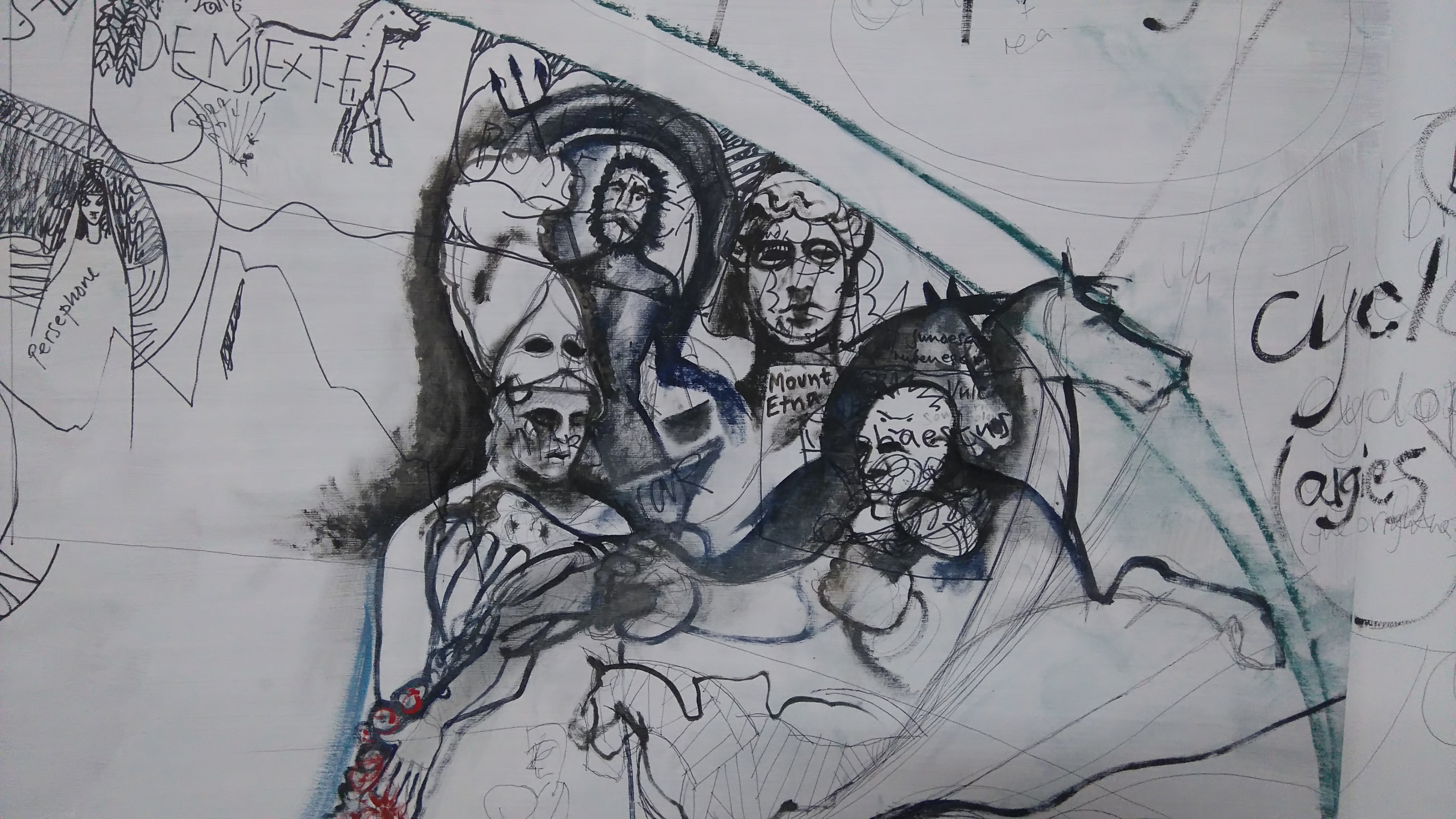
Greek Mythic Dreamers nearing completion
Ceiling paintingsThere are many parts of this complex painting that needs completion, The overall design is more or less finished, but many aesthetic and philosophical considerations are now posing questions.

Uranus covers Gaia
In this detail of the left corner of the painting, Gaia is painted as a female figure made of the earth and all the things that grow on the earth. This border merges into the sea on the right.
You can see the figure of Uranus covering over the upper part, reaching for the embrace, the unwelcome embrace.
When the war is over between the Titans and the Gods the awful 50 headed monster that Uranus rejected was given the task of guardian of the underworld, hence the many arms and many faces of the hekatonkheire beneath the primal Goddess.

Here you can see more of the transition from rock and vegetation into sea (Pontus). The figure between the face of gaia and uranus is another Titan given the job of keeping the earth and the sky separated.
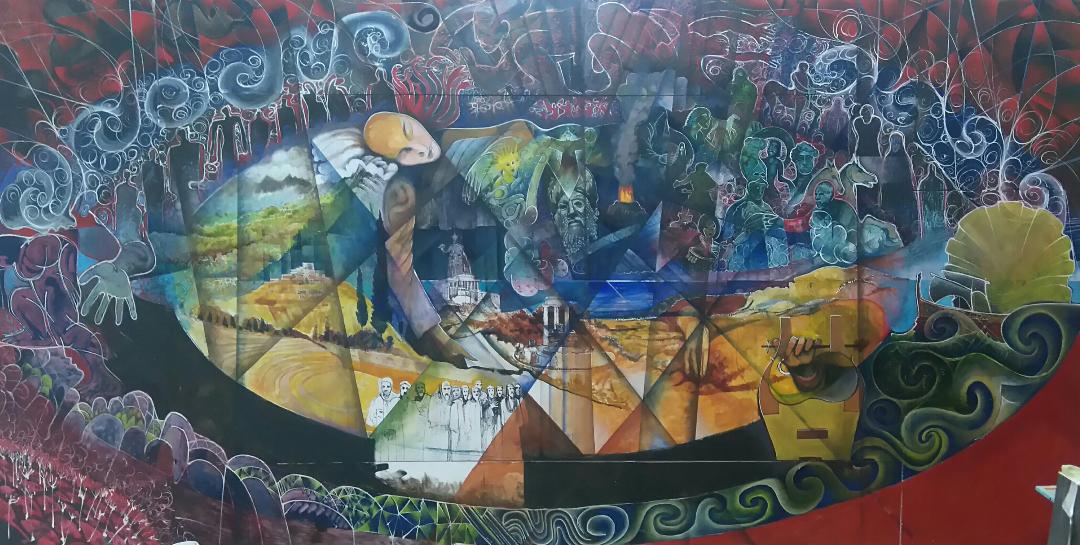
Chaos is in the outer corners, from which the elemental forms of earth and sky begin the story.
A new face for Zeus
Ceiling paintings
Some colour has been introduced into the sky above the acropolis. Karen Cropper has brought to my attention a theory that there was no word for blue in ancient Greek. Homer’s wine dark sea etc…. She will elaborate one day. (There is an interesting article on this subject here: https://greekreporter.com/2023/04/25/did-ancient-greeks-see-blue/ added 08/09/2023)
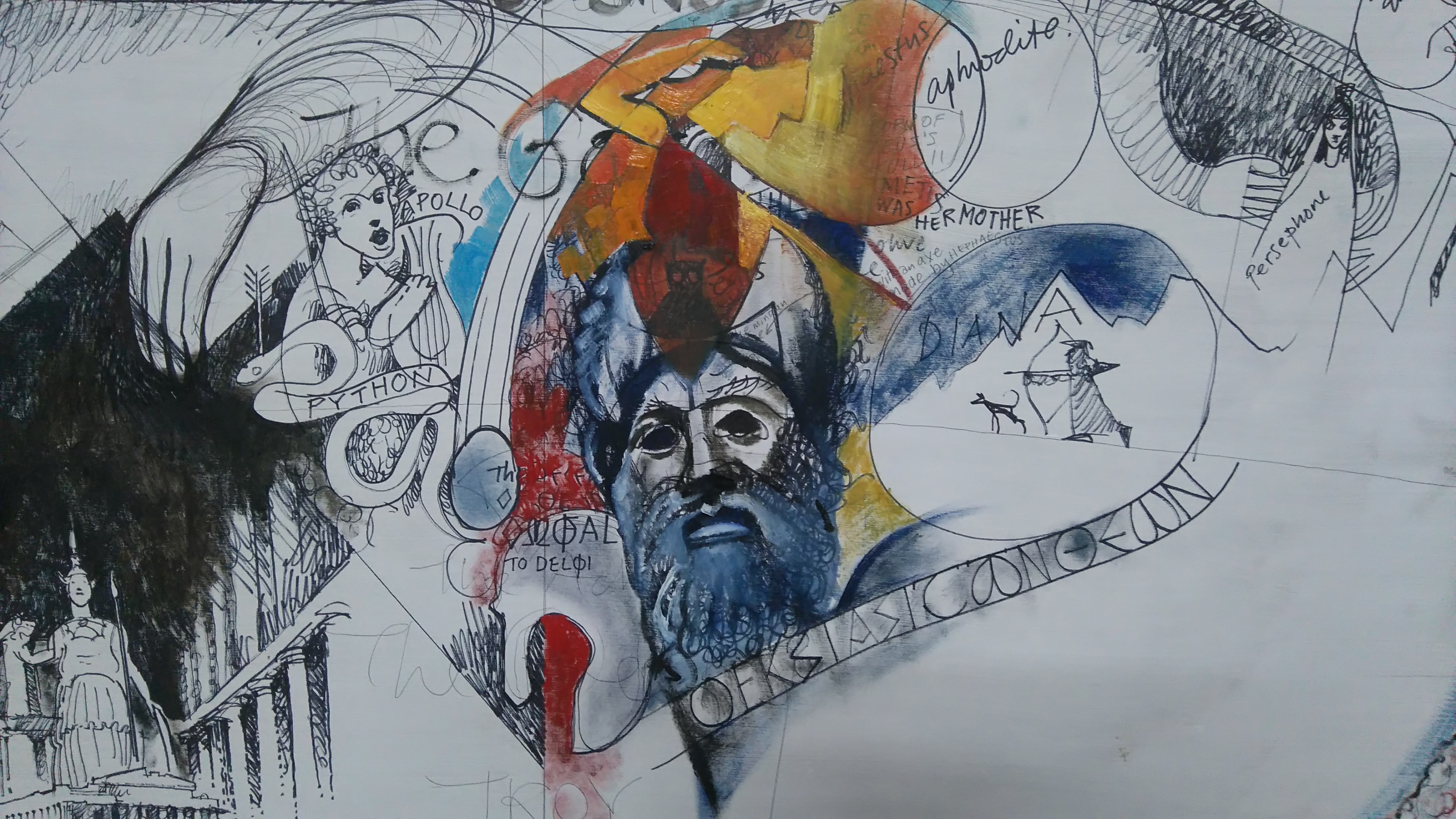
I have reworked the face of Zeus using the face from a famous bronze sculpture. There is a cruelty of the lip that seems appropriate.
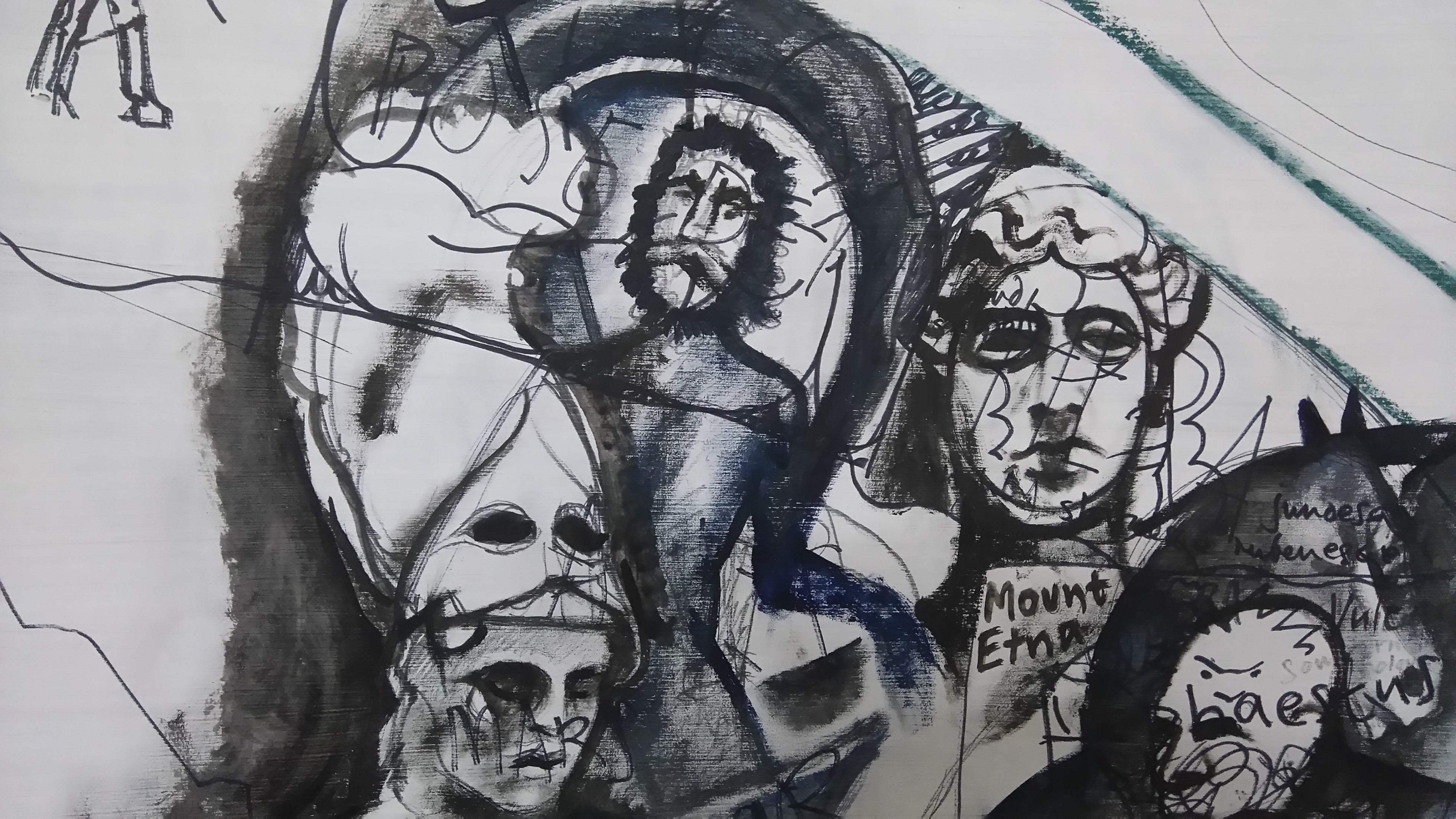
I have used a Roman mosaic as the source for Prometheus driving in a chariot drawn by sea horses.
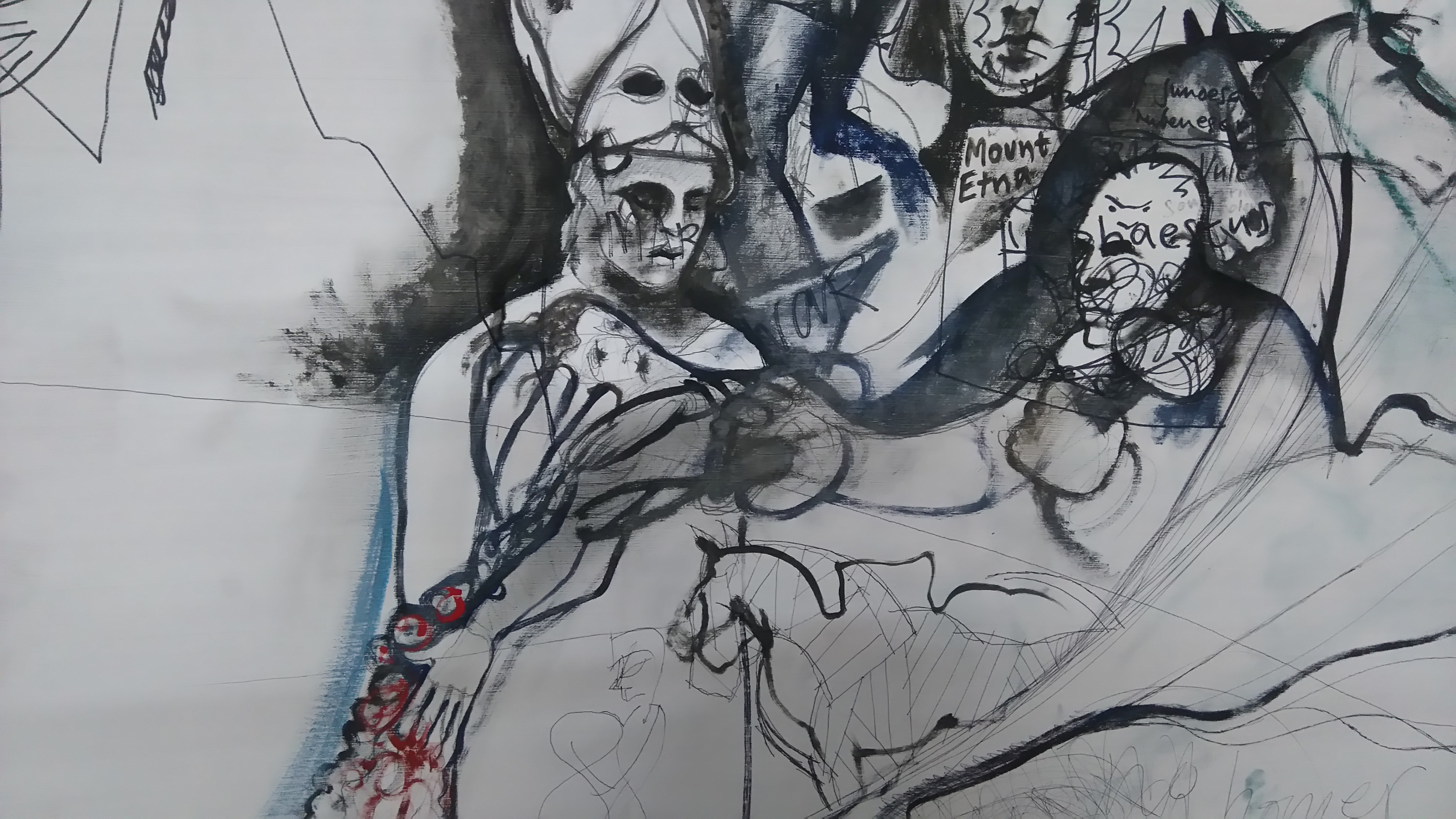
The figure of Prometheus has been developed showing a cascade of fire and hot ash falling from his hand.