The Quest for Erotokritos – Part 1

New work

Stelios who introduced me to ‘Erotokritos’ – 1m x 1m charcoal on canvas

This is the first blog post of a series from my trip to Athens and Crete early in 2023, which has inspired work that will be in my Summer exhibition at St Johns Hall Gallery in Barmouth.

Athens

My trip began on January 25th 2023, initially to visit my sister, Beatrice, in hospital after a heart bypass operation in Athens, and to celebrate our mutual 80th birthday with Becky and Katie, her daughters.

During this time I went into the old Turkish quarter called ‘the Plaka’ to try and find my old haunts when I lived in Athens many years before. At that time, I used to eat in an old taverna, once frequented by Patrick Leigh Fermor and Lawrence Durrell (mentioned by him in ‘Bitter Lemons’). Unfortunately the whole area has been changed by tourism, and the blight has spread to much of Greece.

I couldn’t find the place. Either it is now swamped by tourist shops or has had a facelift. I remember the wide doors open onto a square, an old fellow in the corner endlessly playing the same rembetika tune on a bouzouki. In those days it was a mish mash of characters there, like me, for the cheap food – sailors from Piraeus, groups playing noisy tavla and groups of ‘locals’. Rarely we saw tourists. I recall one tramp-like character leaving after a plate of fasolada, standing in the square outside, lifting his stick horizontally before him and beginning to spin. When he stopped, he walked off in the direction of the pointing stick. I found it a perfect place to eat, write up my diary and correspondence, and gradually float into a haze of Retsina before finding my van and heading up to the phnix’ car park to spend the hours of sleep.

The lure of the music

Now everywhere happy tourists sit being serenaded by bands of musicians. Rembetika has moved from the criminal pot smoking world of the ‘mangas’ to mainstream. It is not nice to witness.

However, I did find, one evening down a narrow alley, a taverna busy with Greeks where I listened to a bouzouki and guitar playing authentic music. I settled down to do some drawing in the outside alley, and recorded this video.

Students and locals seem to meet here away from the foreigners.

Back in the Plaka, the day before we left, I heard the haunting staccato sound of a violin playing just below the acropolis and made this video.

This hasty video was my first glimpse of Stelios.

I don’t know what it was about this sound that caught my attention, but I was aware that it was not the customary sound of contemporary Greek music. I had become familiar with ‘rembetika’ when I previously lived in Athens and later in Thessaloniki. This is the music that evolved in the ghettos after the population exchange of 1922. The Greeks call this event the ‘Greek Genocide’. Puntic Greeks, many impoverished, arrived from their traditional towns and cities on the east coast of Turkey and set up shanty towns on the outskirts of mainland Greek cities. Some wealthy Greeks too. I gave private English lessons in Thessaloniki to a very lordly man whose family had owned rich lands on the Menander river, a river that wound a tortuous course now called ‘Buyuk Menderes’ whose delta emerges into the Adriatic just south of Izmir. Our word ‘to meander’ comes from this river. These refugees brought Turkish instruments, notably the bouzouki.

On the Greek islands you can hear music from older traditions, much peasant communal music made for dancing, rural music celebrating agricultural events, weddings and such like.

But this music was different, from a different tradition, or so it seemed to me, and that hunch turned out to be right.

Introduction to Erotokritos, the Quest begins

Later I spoke with Stelios in a second video and he told me that his father was from Hiracleon in Crete. The tune he played was called ‘Erotokritos’, based on a famous love song which, he informed me, influenced Shakespeare’s ‘Romeo and Juliet’. The best performer he said was Nikos Xylouris who played it on the Lyra accompanied by the lute (awde).

Here I interview Stelios and learn the origins of this mysterious music.

So the strange music was from Crete, where I was due to travel soon.

I hate visiting a country as a tourist. I was looking for something interesting to get my teeth into. Here was something worth examining. I felt sure that a quest for ‘Erotokritos’ would enable me to dig deeper. I now had mysterious music, an ancient poem contemporary with Shakespeare and a new instrument ‘the Lyra’ to explore.

Canu Gyntaf – First Poem

New work, Smaller Paintings
Painting copyright Bernard Barnes

Canu Gyntaf – First Poem. Oil on Canvas 60 x 80 cm

This is a recent painting (August 2022). The scene is close to where I live on the Rock in Barmouth. It inspired me to write my first poem in Welsh.

Canu cyntaf

Dw i’n gallu gweld
Lle mae pedair ffordd yn cyfarfod
Tri rhes o risiau
Diflannu i’r mynydd
Ar hyn o bryn
Symudiad bach,
Yn y twll du.
Goch a gwyn llachar
Yn sydyn
Dau berson bach
Ganwyd o bell
Fel y greadigaeth

First poem

I can see
Where four roads meet
Three flights of stairs
Disappear into the mountain
On this hill
small movement,
In the black hole.
Bright red and white
Suddenly
Two little people
Borne from afar
Like the creation

The Story of Parasitic Cities

Fusion paintings, New work, Past work

Over the last two years of restrictions, because of the Pandemic, I have been working on an exhibition that brings together many strands that I have been working on and thinking about throughout my life. I conceived the exhibition to allow people to visit safely without coming into contact with anyone else. So initially there were timed visiting slots that had to be booked in advance. But now that there is less risk and reduced legal restrictions, people can attend at any time without booking.

The exhibition is a labyrinth controlled by raspberry pi computers, which lead visitors around the 10 rooms. The narrative that accompanies the many paintings examines the evolution of the monstrous parasitic cities that are threatening our planet. (It is probably not suitable for children.)

The sound and light experience currently starts every hour on the hour, 11 am to 3pm. The gallery is open 11 am to 4:30pm Tuesday to Saturday. Closed Sunday and Monday. The tour takes about 50 minutes to go through from start to finish, but you can join it at any point and loop round to see the bit you missed. A donation of £5 per person is suggested, if you are able to support the gallery. Please check the gallery website before making a special trip in case there are any changes to the arrangements since writing this post.

Prior to the exhibition being open, I created a virtual version online as a preview. This has been updated a little and is now available for anyone who wants that experience. It is now on this website.

Fusion ‘UKEU’

Fusion paintings

I have cut the union jack and the EU flags along the same grid.

I am now able to rearrange the designs, fusing them in different ways, in the way the two European entities are presently arranged.

On the back, reminiscent of board games, can be found images connected with European events, remarkable people etc.

A huge variety of arrangements can be made.

As this bald eagle proves.

Or this.


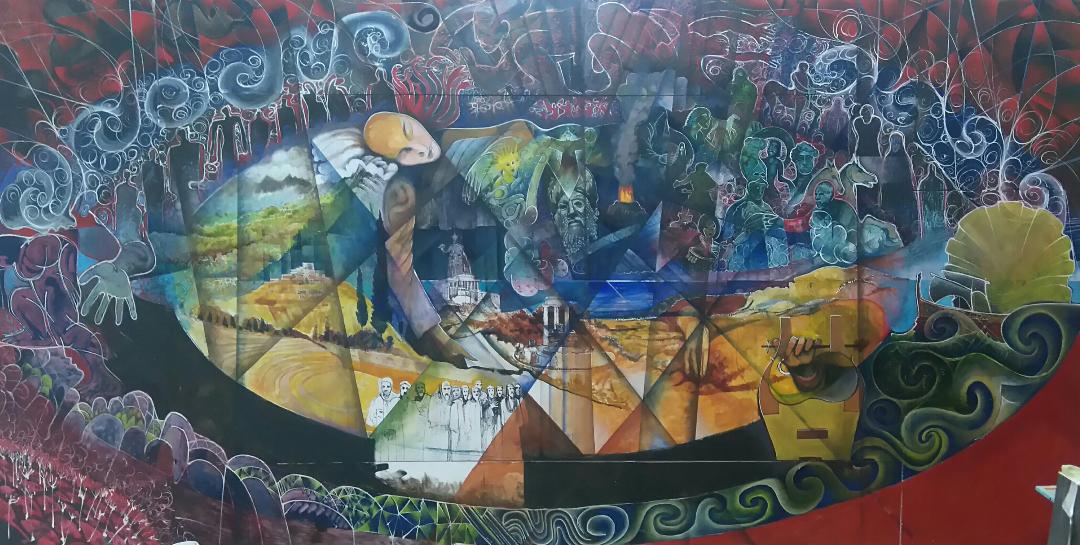
Greek Mythic Dreamers nearing completion

Ceiling paintings

There are many parts of this complex painting that needs completion, The overall design is more or less finished, but many aesthetic and philosophical considerations are now posing questions.

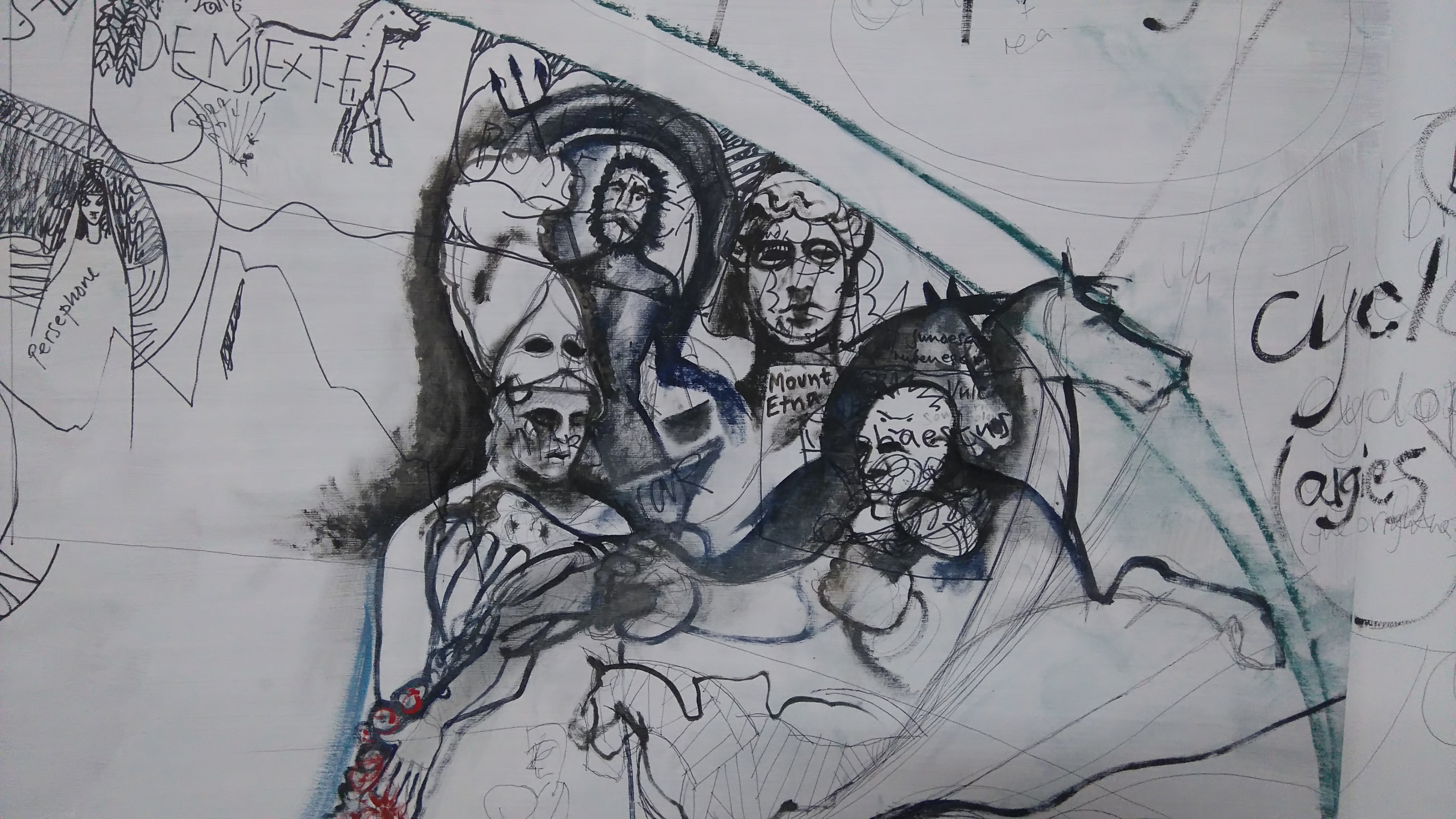
Uranus covers Gaia

In this detail of the left corner of the painting, Gaia is painted as a female figure made of the earth and all the things that grow on the earth. This border merges into the sea on the right.

You can see the figure of Uranus covering over the upper part, reaching for the embrace, the unwelcome embrace.

When the war is over between the Titans and the Gods the awful 50 headed monster that Uranus rejected was given the task of guardian of the underworld, hence the many arms and many faces of the hekatonkheire beneath the primal Goddess.

Here you can see more of the transition from rock and vegetation into sea (Pontus). The figure between the face of gaia and uranus is another Titan given the job of keeping the earth and the sky separated.

Chaos is in the outer corners, from which the elemental forms of earth and sky begin the story.


A new face for Zeus

Ceiling paintings

Some colour has been introduced into the sky above the acropolis. Karen Cropper has brought to my attention a theory that there was no word for blue in ancient Greek. Homer’s wine dark sea etc…. She will elaborate one day. (There is an interesting article on this subject here: https://greekreporter.com/2023/04/25/did-ancient-greeks-see-blue/ added 08/09/2023)

I have reworked the face of Zeus using the face from a famous bronze sculpture. There is a cruelty of the lip that seems appropriate.

I have used a Roman mosaic as the source for Prometheus  driving in a chariot drawn by sea horses.

The figure of Prometheus has been developed showing a cascade of fire and hot ash falling from his hand.

Preparations for the Greek Mythic Dreamer

Ceiling paintings

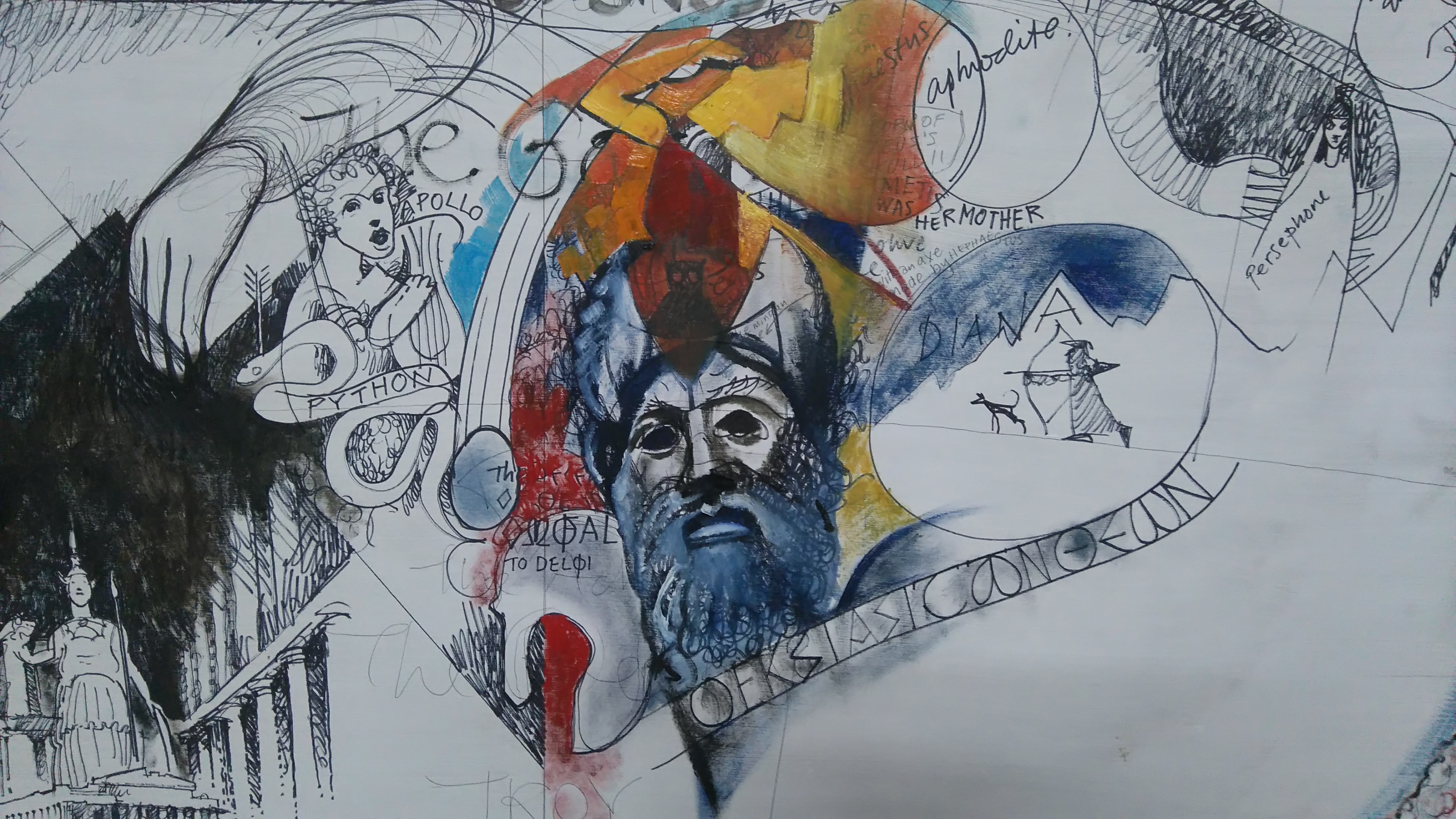
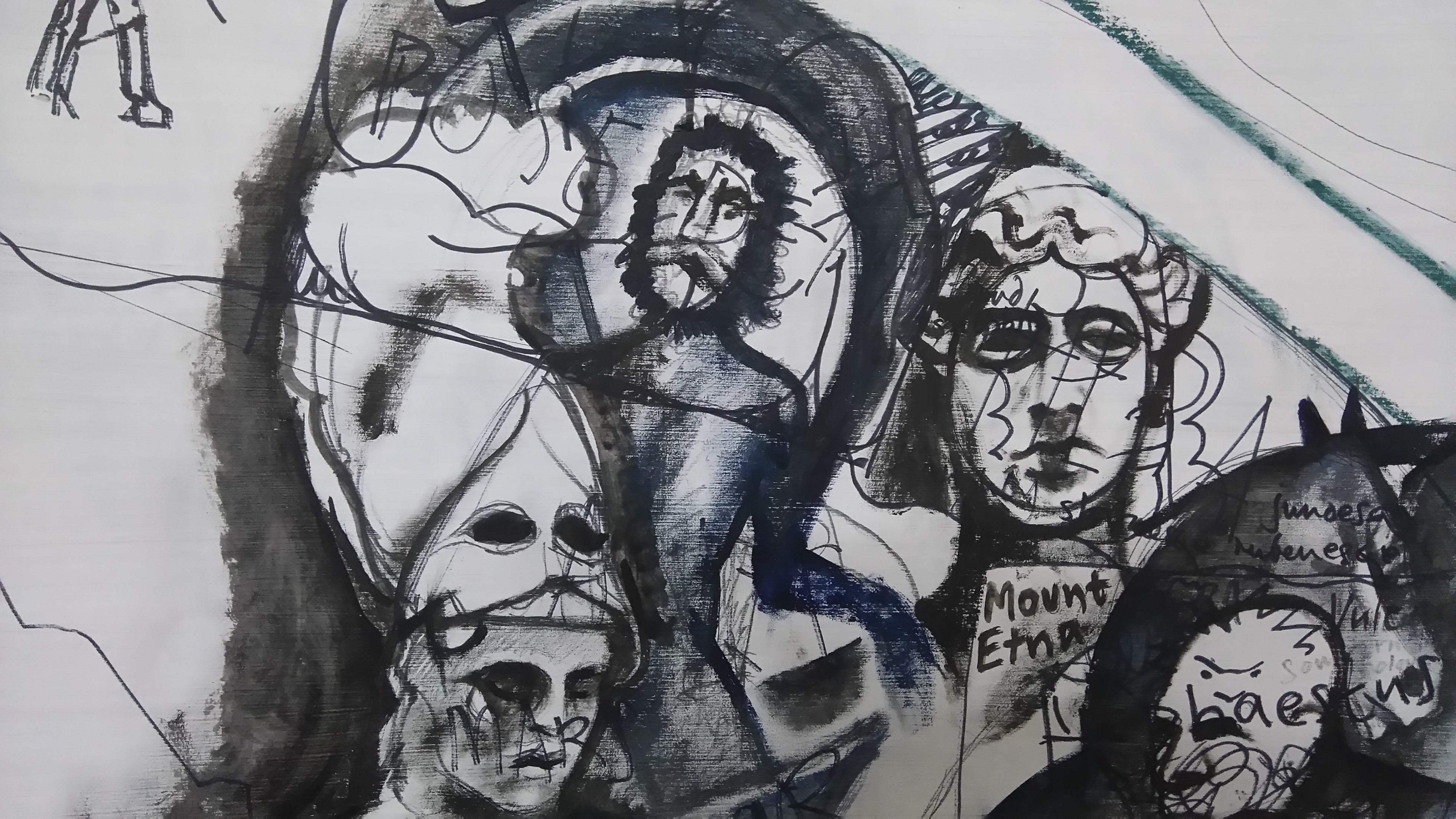
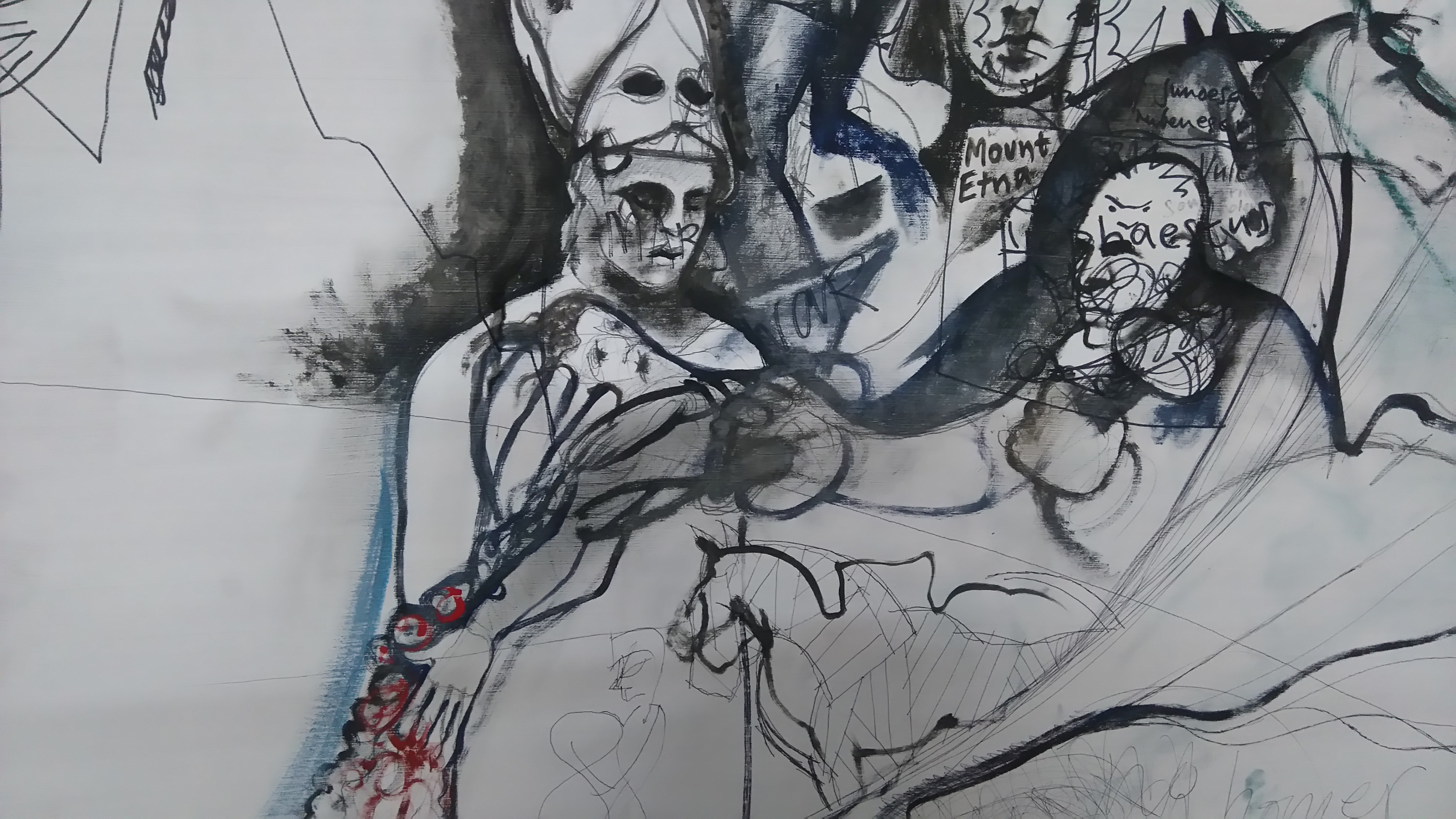
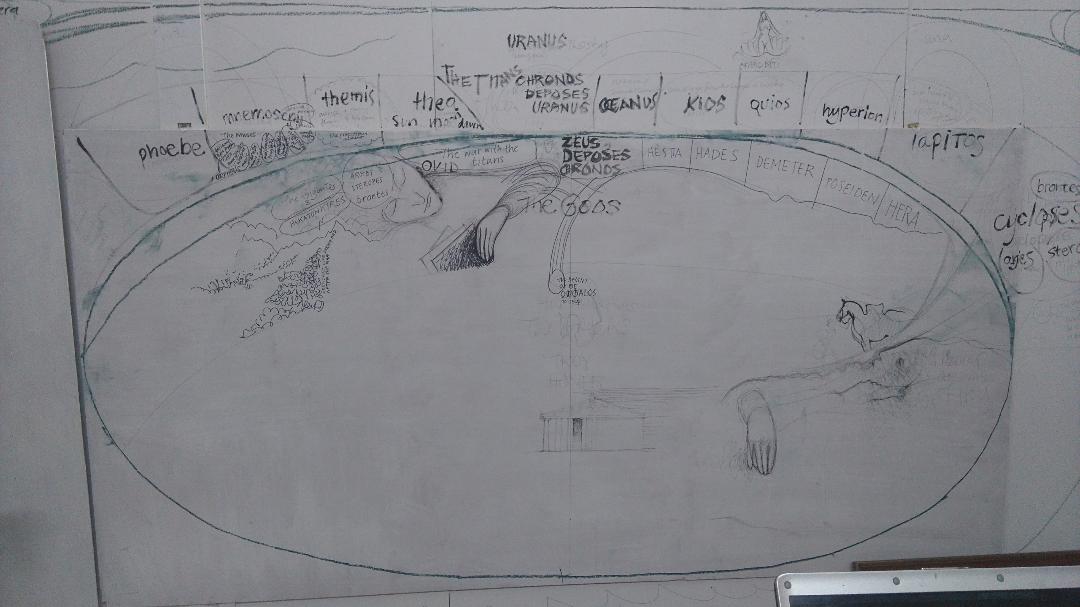
I am beginning to plot out a diagram that is rapidly becoming preposterously complicated. As it outlines the Greek’s mythic view of the world, I suppose that is not surprising.

Using a combination of sources including Ovid, to whom this painting is dedicated, Stephen Fry, Robert Graves, Homer and a life time of fascination with all things Greek, I am trying to assemble an image that reflects the mass of interwoven stories from antique origins that pictures some part of the mythic world of those brilliant people.

We find a world story, pieced together from many threads, containing a cornucopia (another Greek invention) of Titans, Gods, Elemental forces, Naiads, Dryads, Furies, Muses, Powers of night, darkness, doom, hubris and so on. I have come across the Hekatonkheires for the first time, so ugly to Ouranos that he thrust them back into Gaia’s womb. As I listen to the stories I have been scribbling on the board that may or may not end up being the painted surface.

Once again the painting is turning into a research document.

So we have the sleeping figure of Ovid at the top of the inner rectangle (I have begun by following the pattern of the earlier two panels, with 8×4 inner panel, and outer framing panels. I see him asleep in his lonely exile overlooking the wastes of the black sea on the northern borders the empire. Around him are the stories of the titans and the gods that he wove into his Metamorphosis.

Below in the lower part of the painting there is another dreamer. Homer sleeps the dream of the Trojan wars, of the Illiad and the Oddesey, and the world of man is linked to the Gods.

There must be reference to the city state, the polis, the development of the academies of philosophy, the mystical dionysian and orphic sects and the many connections that link this extraordinary flowering of culture to ancient lineages and the following military might of Rome.

I ask myself as I begin this picture what the mythic and spiritual world was like for a Greek.