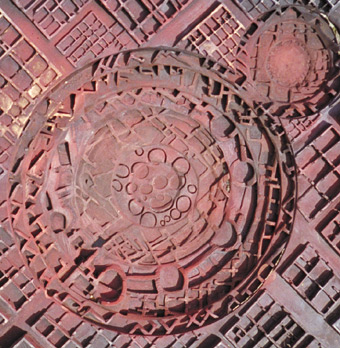
Craters
Wooden Sculpture
Being Added To
|
|
THE
ANATOMY OF THE CITY
The BODY of the superorganism cannot simply be seen by looking at
a town plan, any more than the living mollusc could be seen by examining
a sea shell. Even if the roofs of the buildings were removed to
reveal the thousands of small interconnected spaces, the corridors,
valves, stairways and lifts of the inner labyrinths, the whole body
would not be visible. You still could not see the pipes and wires
embedded in the walls and floors, the thousands of artifacts from
furniture and machinery to peas and pins, which are less permanent
types of membrane. Nor would the living individuals be illustrated,
ceaselessly milling and pausing in the streets and rooms, each one
covered in layers of woven membrane like a complicated cocoon.
In actual fact a superorganic city is packed with different types
of membranes and tissues, each of which has its place within the
whole. Only a few hard or precious objects will survive for long,
and these may become buried in the foundations, which are another
part of the living body that a town plan will not reveal. The transient
living surface, the skin of the city, is only the surface layer,
in some cases, of strata of buried tissue, imposing their resonant
codes on the present, often without our knowledge.
The normal town plan will not reveal the parts of the superorganism
that are outside the town walls or bounderics. Out there are fields
and quarries which are essential parts of its body. That is where
a city photosynthesises, grows meat, hair and bone 'on the hoof',
claws stone and sifts metal. The town plan illustrates the compact
and immensly complex structural centre to a larger whole. Out in
the fields other membranes called 'walls' divide carrot from cabbage,
sown from wild, in characteristic patterns, like a net cast over
the earth around the vigorous centre.
|